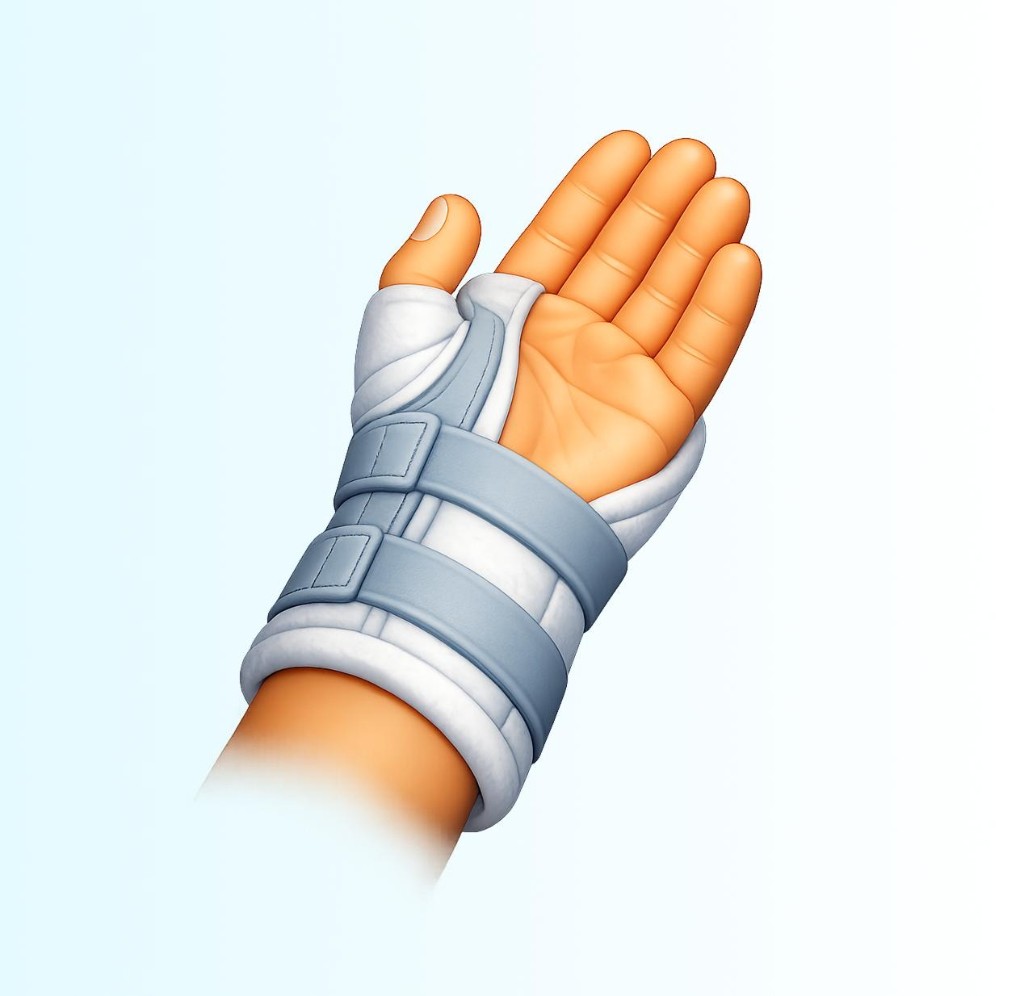
Thumb dynamic band pulls
Resisted thumb abduction / extension vectors with elastic band
Goal
Bands provide smooth resistance for APB/EPL lines and multi-vector control without heavy pinch compression.
Motion taxonomy (reference)
Also called: thumb abduction band resistance · thumb static strengthening vectors
Muscles — abductor pollicis brevis, abductor pollicis longus, adductor pollicis, extensor pollicis brevis, thenar muscles, thenar stabilizers
Tendons — thumb abductor tendons, thumb stabilizer tendons
Bones / joints — first metacarpal, thumb CMC joint, thumb MCP joint
Indexed benefits: improves CMC stability · improves control in multiple directions · strengthens thumb abductors · strengthens thumb stabilizers · supports CMC stability · supports functional pinch
Common contexts: CMC rehab · CMC stability · resisted strengthening · return to pinch · thumb weakness
Best for
- Thenar endurance
- CMC stability
- Controlled multi-vector strength
Default dose
10 reps • 2 sets • 2×/day
Equipment
Light resistance band
Avoid when
- Basal thumb acute flare
- De Quervain aggravation
Measurement targets
- Reps to mild fatigue
- Band color progression
Setup
- Loop a light band around thumb and index MCP region; forearm supported.
Steps
- 1Move the thumb away from the index finger against the band.
- 2Add slow up-and-down and slight sideways vectors while keeping the hitching smooth.
- 3Return with control; avoid snapping.
Cues
- Low resistance first.
- Stop if pinch base aches into the night.
Common mistakes
- Shrugging the shoulder or hiking the wrist.
Stop if you feel
Stop rules
- Sharp pain (≥ 4/10)
- Increasing swelling during or after
- New or worsening numbness or tingling
- Color change in fingers (pale, blue, red)
- Wound opens, drains, or feels hot
- Next morning is worse than the day before
Progressions
- Slightly stronger band when 48 h response is calm.
Regressions
- Isometric holds mid-range only.
Used in(3 guided demos)
Search the exercise library with this motion's clinical label for additional guided drills that may match your plan.
What to do next — not a dead end
Suggestions use body region, goal, motion type, and allowed phases — not your medical record. After surgery or a flare, follow your clinician first.
Short sets — often 2×10 as a micro-session
10 reps · 2 sets · 2×/day
Light resistance band
Phases 3, 4
Higher load or coordination — scale range and speed.
Avoid if this sounds like you
Basal thumb acute flare
De Quervain aggravation
Reread best-for context ↑Where this shows up clinically
How phases map to healingNext best movements
Later phase or richer progression when you are ready.
- Radial deviation isometric (table)strength · moderate risk · progression
- Ulnar deviation isometric (table)strength · moderate risk · progression
- Pronation isometric bracestrength · moderate risk · progression
- Supination isometric bracestrength · moderate risk · progression
- Tip pinchstrength · moderate risk · progression
Prerequisite / gentler lane
Same region and intent — usually earlier phase or lower risk.
Commonly paired with
Different primary goal, same region — typical mixed sessions.
- Light loaded carryendurance · moderate risk · complementary
- Thumb retropulsion (lift)mobility · moderate risk · complementary
- Thumb tip bendtendon-glide · moderate risk · complementary
- Thumb IP blockingtendon-glide · moderate risk · complementary
- Thumb MCP blockingmobility · moderate risk · complementary
Related movements
Similar mechanics, goals, or anatomy.
- Wall weight bearingstrength · moderate risk
- Wrist curl (light)strength · moderate risk
- Pad-to-side pinchstrength · moderate risk
- Flat pinch (lateral pinch plate)strength · moderate risk
- Mass gripstrength · moderate risk
- Radial deviation isometric (table)strength · moderate risk
- Ulnar deviation isometric (table)strength · moderate risk
- Pronation isometric bracestrength · moderate risk
Guided exercises that use this
Step-by-step sessions that embed this movement pattern.
Keep momentum without overdoing it
Log a short check-in to protect your streak — even one quality set counts.